
What actually happens inside a laboratory fume hood when a chemical releases hazardous vapours?
You may see the vapour disappear, but you cannot see the airflow capturing it, moving it through the hood and carrying it towards the exhaust. That invisible process is what makes a fume hood more than a simple laboratory enclosure. A properly engineered hood brings together airflow, containment, exhaust, service fixtures, electrical provisions, construction materials and work surfaces to create a controlled working environment.
This is why the role of experienced laboratory fume hood manufacturers goes far beyond fabricating a cabinet and connecting it to an exhaust system. The hood needs to work with the laboratory’s processes, chemicals, equipment and available space. When every component is considered as part of the same system, the result is a fume hood that is not only functional but also practical for everyday laboratory work.
Airflow Is Where Safety Begins
The primary purpose of a laboratory fume hood is to capture and remove hazardous contaminants at their source. Air is drawn through the front opening of the hood and directed through the internal airflow system before being exhausted through connected ductwork.
The exhaust fan creates the pressure needed to move contaminated air away from the working area. However, simply moving air is not enough. The airflow needs to remain controlled and consistent to support proper containment.
This is where components such as the sash, baffle, and air foil become important.
The movable sash helps control the opening of the hood, while the internal baffle helps distribute suction across the working area. A three-point suction baffle design can support more effective and uniform removal of fumes. Around the hood face, the air foil helps reduce sharp airflow changes and turbulence, allowing air to enter the enclosure more smoothly.
In other words, a reliable fume hood is an airflow system engineered around containment—not simply a cabinet with an exhaust connection.
Laboratory Fume Hood Manufacturers Build More
A laboratory hood also needs to support the practical work happening inside it. That means service fixtures and fittings are not secondary details; they are part of the overall laboratory setup.
Labofab’s fume hood configurations can include remote-control valves with IN and OUT facilities and flexible hoses. Colour-coded washers and index handles make services easier to identify and control from outside the hood.
Electrical services are also integrated according to laboratory requirements, with single-phase, 50 Hz electrical receptacles rated at 230 V AC and available in 6/16 Amp configurations.
The base is another important element. The upper hood unit is mounted on robust base cabinets, with a high-performance chemical-resistant, corrosion-proof and fire-retardant powder-coated finish designed for demanding laboratory environments.
These details matter because laboratory work is rarely limited to one activity. A well-designed hood needs to accommodate equipment, utilities, chemical handling and day-to-day laboratory operations without compromising the working environment.
Materials Matter Inside the Hood
The interior of a fume hood is exposed to chemicals, heat, spills, and continuous laboratory activity. The materials used for the enclosure and work surface therefore have a direct impact on durability and maintenance.
Labofab uses high-quality furniture-grade GPSP with an “O” spangle finish for its fume hood construction, while the superstructure is finished with a chemical-resistant, corrosion-proof, fire-retardant powder coating.
The work surface can be specified according to the application. Options include dished black granite, ceramic, solid epoxy resin, and phenolic resin. For specialised applications such as radioisotope and perchloric acid hoods, dished or raised-edge stainless-steel work surfaces can provide an appropriate solution.
A non-porous, smooth, and chemical-resistant work surface also makes routine cleaning easier. This is particularly important in laboratories where residues and spills cannot simply be treated as ordinary dirt.
The right material is therefore not just about appearance. It needs to withstand the conditions created by the work taking place inside the hood.
Compact Spaces Need Smart Design
Not every laboratory has the floor area for a large hood installation. This is where a benchtop fume hood can become a practical solution.
Benchtop models provide a compact enclosure that can be integrated into an existing laboratory worktop while still supporting essential fume extraction and containment requirements. Smaller does not mean simpler—the airflow, materials, services, and working configuration still need to work together.
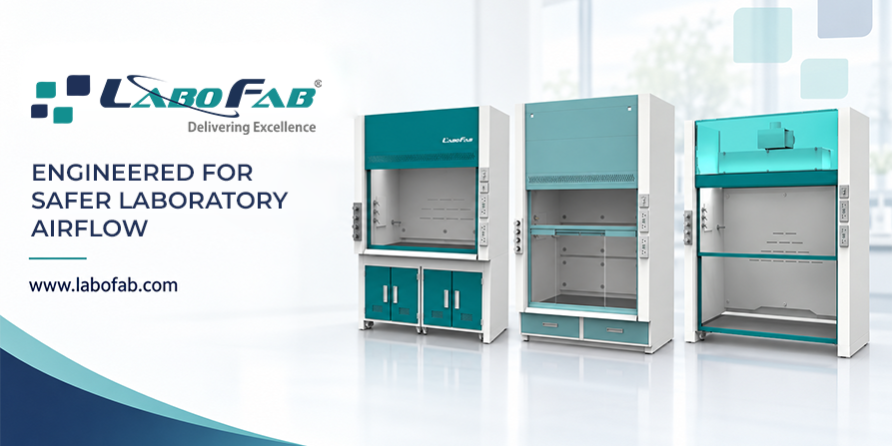
Labofab offers different configurations, including Bench Top Fume Hood, Walk-in Fume Hood, and Low Bench Fume Hood, allowing the system to be matched to the laboratory’s working requirements.
As a manufacturer & supplier of lab fume hood, Labofab focuses on combining airflow engineering, durable materials, integrated services and practical configurations into laboratory fume hood systems designed for demanding environments.
The goal is straightforward: create a controlled workspace that helps laboratories manage hazardous fumes without making everyday laboratory work more complicated.
Need a fume hood designed around your laboratory requirements?
Connect with Labofab for laboratory fume hood systems built around safety, performance and practical laboratory use.
Frequently Asked Questions
- What is the purpose of a laboratory fume hood?
A laboratory fume hood captures and exhausts hazardous fumes, gases, vapours and airborne contaminants generated during laboratory procedures. - How does a lab fume hood work?
Air is drawn through the hood opening, guided through its internal airflow system, and exhausted through connected duckwork to help control contaminants at their source. - What is a benchtop fume hood?
A benchtop fume hood is a compact fume extraction enclosure designed to sit on a laboratory work surface, making it suitable for laboratories with limited space. - What work surfaces are available for fume hoods?
Depending on the application, work surfaces can include black granite, ceramic, solid epoxy resin, phenolic resin, and stainless steel for specialised applications. - What should laboratories look for in fume hood manufacturers?
Look beyond the enclosure itself. Airflow design, baffle configuration, sash operation, materials, service fixtures, work surfaces, durability, and installation requirements should all be considered.